
Appearance
About MetaSafe
Revolutionary Shock Absorption Technology
Shock absorption is a crucial function designed to protect objects, structures, or living organisms from the damaging effects of sudden impacts. An ideal shock-absorbing material is one that exhibits exceptional energy absorption capabilities during such events. It should possess properties such as progressive collapse with a constant deceleration that maximally absorbs impact forces. At the same time, it should exhibit high stiffness and strength to act as a load-bearing structure.
Breaking Traditional Trade-offs
Structures traditionally used in the automotive industry, e.g., crash cans or structures based on arches, are either stiff or dissipative but not both. Our technology, MetaSafe (patent WO2025061777A1, developed in the NWO TTW project 17883 in collaboration with the University of Amsterdam and Tata Steel, and recently featured in Nature), combines high stiffness and high dissipative capacity.
The metamaterial is 100 times stiffer and 20 times more dissipative than current solutions used for shielding batteries.
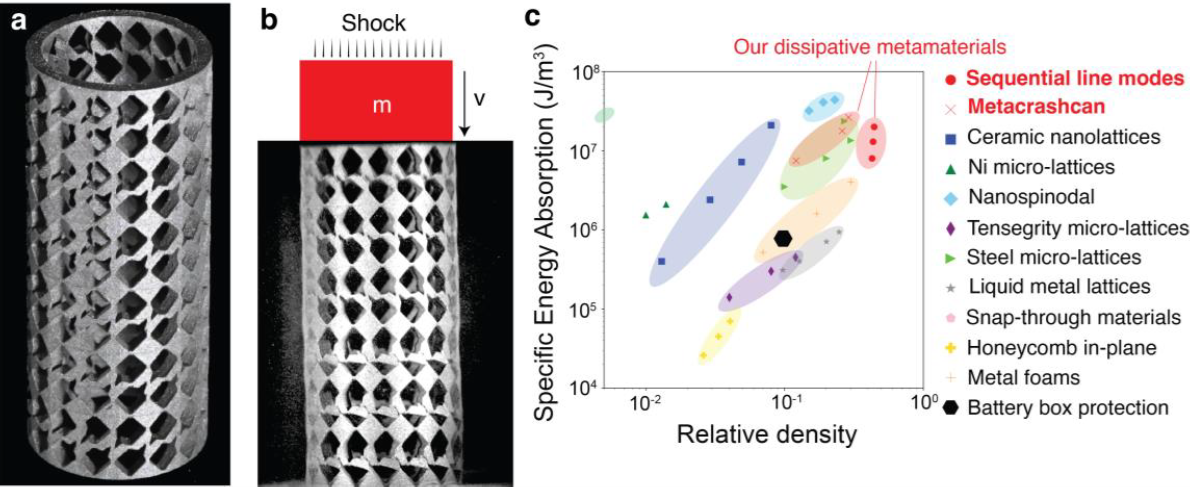 Figure 1: (a) Our dissipative metamaterials. In contrast with traditional structures and metamaterials, which have an inherent trade-off between stiffness and dissipation, our dissipative metamaterials exploit a particular occurrence of elastoplastic buckling, which make them buckle in a controlled sequence upon compression or shocks (b). (c) As a result, they exhibit an exceptionally high dissipation to weight ratio, which beats all traditional structures by orders of magnitude.
How It Works
The patented yield-buckling mechanical metamaterial architecture exploits a controlled interaction between geometric buckling and material plasticity, producing a stable, repeatable force plateau during deformation. Each metamaterial layer is engineered to buckle precisely at the onset of yielding, enabling:
- Predictable, sequential energy dissipation
- Significantly reduced stroke length requirements compared to conventional crash cans
- 30-60% reduction in component weight while maintaining or improving crash performance
- Increased BEV driving range and reduced CO2 footprint
Commercial Viability
In this feasibility study, we will establish these dissipative metamaterials as a commercially viable solution for a new generation of battery enclosures. Unlike nanoprinted metamaterials that achieve similar performance, our metamaterials can be produced at large scale, making them viable for the automotive sector.
Applications Beyond Automotive
Beyond the EV sector, this new generation of dissipative metamaterials holds potential applications in:
- Aerospace - Lightweight structural protection
- Defence - Impact-resistant systems
- Personal Protective Equipment - Advanced helmets, body armor, and sports protection
- Seismic Protection - Building and infrastructure safety
- Industrial Applications - Where lightweight, high-performance shock absorption is critical
Our technology represents a paradigm shift in protective materials, offering unprecedented combinations of properties that were previously impossible to achieve.